If you are researching how to use AI for business, you are looking for leverage, speed, and strategic advantage.
I use these tools heavily for exactly those reasons. Daily. Strategically. Across real business initiatives.
But in my work, I’ve noticed a hidden trap that most tutorials miss.
At first, AI answers are sharp, structured and genuinely helpful. The thinking is clear and the guidance makes sense. You start to trust it.
Then gradually, something changes.
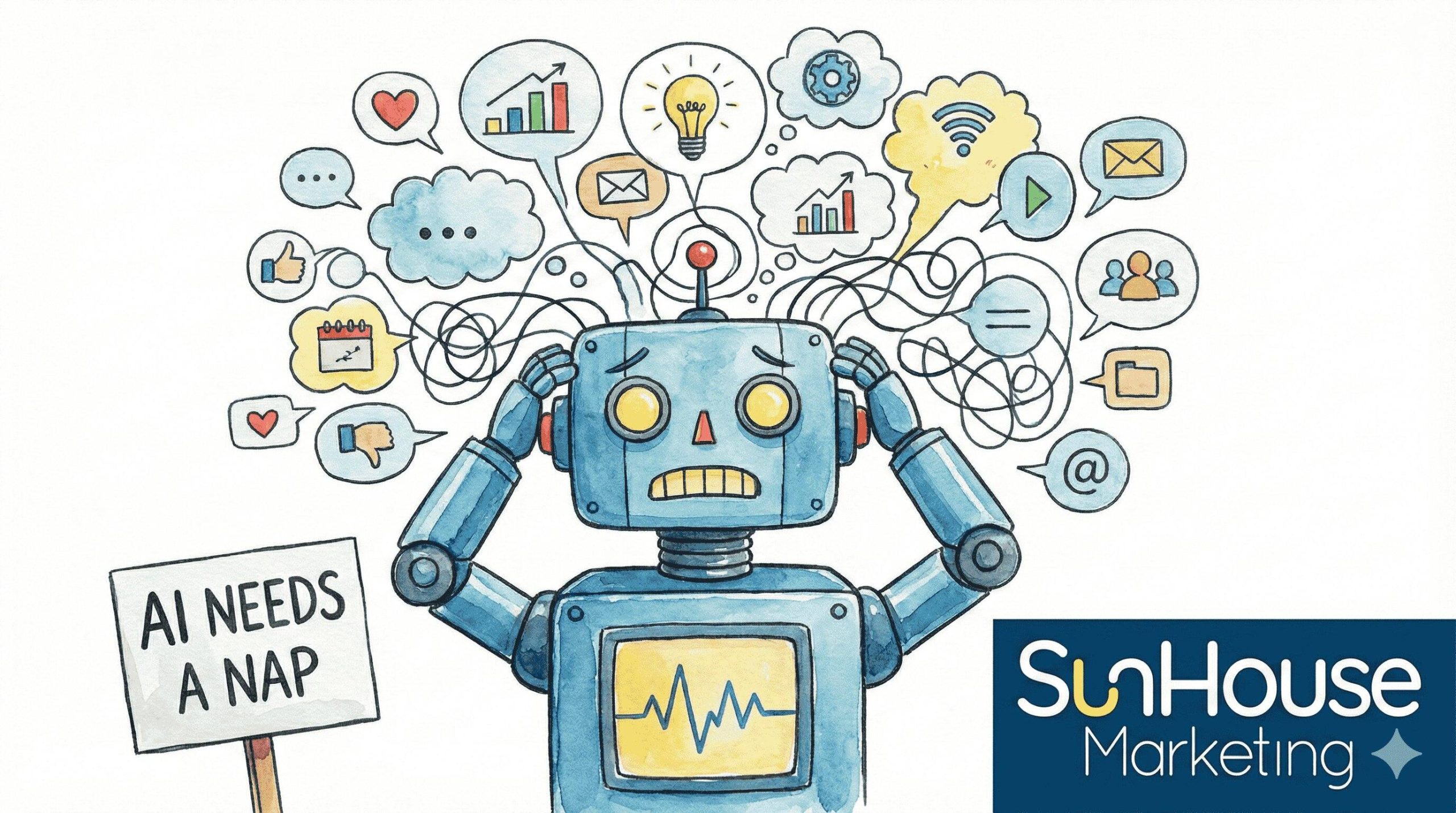
The longer the conversation goes, the sloppier the responses start to feel. Instructions get diluted, answers get repetitive, and accuracy drops. It looks and feels like the AI is “getting tired.”
The quality slips. Instructions drift. Small mistakes creep in. They are not obvious errors, but in a way, more dangerous: subtle nuances that look correct but are strategically off.
If you’re not paying close attention, you won’t notice them at all.
I coin this AI Fatigue.
What Is AI Fatigue?
It’s not the AI “getting tired.” It doesn’t have emotions, motivation, or frustration. This is a well-documented technical effect known in AI research as long-context degradation or instruction drift.
Why It Happens (Technically Speaking)
Modern language models operate by evaluating the entire conversation each time they generate a response. As a thread grows longer:
Context entropy increases (the system begins to compress older messages, losing important nuance).
Instruction deflation sets in (the model gradually deviates from original constraints).
Interference patterns accumulate (similar but conflicting instructions start competing inside the model’s attention layers).
In simple terms: Long threads introduce statistical noise that degrades precision over time.
Why This Is a Real Business Risk
In the early stages of a conversation (the “clean slate” phase), AI performs exceptionally well. It provides clear structure, logical sequencing, and sensible recommendations.
That early success builds trust. You feel like you have a competent partner.
The problem arises in long, ongoing threads. Gradually:
Earlier instructions lose precision
Key constraints get diluted
Conflicting guidance starts competing in the background
Researchers refer to this as “context drift”.
In plain English: the conversation environment becomes too noisy for the AI to navigate accurately. The AI doesn’t suddenly fail with an error message, but it does subtly drift while sounding completely confident.
These tools promise efficiency and insight. But many business leaders are now asking a critical question: “How can AI help my business if I can’t trust the output after ten minutes?”
The hard truth is, it can’t.
For business decisions, that “quietly unreliable” input is not just annoying—it is a liability.
Why Most People Miss It
AI Fatigue doesn’t announce itself. There is no error message, no red flag, and no system crash.
Instead, you get:
Slightly off recommendations.
Advice that ignores earlier constraints.
Suggestions that are “mostly right” but contextually wrong.
In marketing strategy or operations, “mostly right” is expensive. It costs time, money, and momentum.
Understanding this distinction is the difference between leaders who get leverage from AI and those who quietly lose confidence in it.
How Smart Business Leaders Avoid AI Fatigue
You won’t find this in standard tutorials.
Here is the operational protocol I use to maintain accuracy.
Adopt these guidelines for yourself, and mandate them for your teams:
1. Keep threads short: One Problem, One Thread Do not reuse one conversation forever.
New project? New thread.
New phase? New thread.
New decision? New thread. This simple discipline eliminates a vast majority of fatigue issues.
Every major task should start in a fresh thread. This resets the model’s context and massively improves accuracy.
2. Break Work into Phases, Not Marathons Don’t ask AI to “Help me build my entire marketing plan.” Instead, execute in discrete blocks:
Thread A: Positioning
Thread B: Messaging
Thread C: Channel Strategy AI excels at focused problems, not sprawling epics.
3. Summarize your project every 10–15 turns
Tell the AI:
“Pause and restate the key facts and instructions so far.”
This resets drift.
4. The “Zero Memory” Rule If a constraint matters—budget, platform, industry, brand voice—state it at the start of every new thread. If a detail is mission-critical (“We’re using Excel not Google Sheets”), restate it up front. Assume the AI has zero memory of your previous conversations.
5. Don’t Over-Correct Endless back-and-forth corrections increase the noise in the context window. If a conversation starts to feel fuzzy, stop. Do not argue with the AI. Reset. Start fresh.
6. Treat AI as Leverage, Not Final Authority AI is there to accelerate thinking, structure ideas, and surface options. The final judgment still belongs to you.
The Consultant’s Takeaway
AI Fatigue isn’t a flaw in the software. It’s the natural result of a cluttered conversation.
Expert users getting real value from AI are the ones who know when to reset, refocus, and re-frame.
Used correctly, AI is the ultimate leverage for your time. Used incorrectly (or with too many direction changes), it becomes a risky distraction. Knowing the difference is now part of running a successful business.