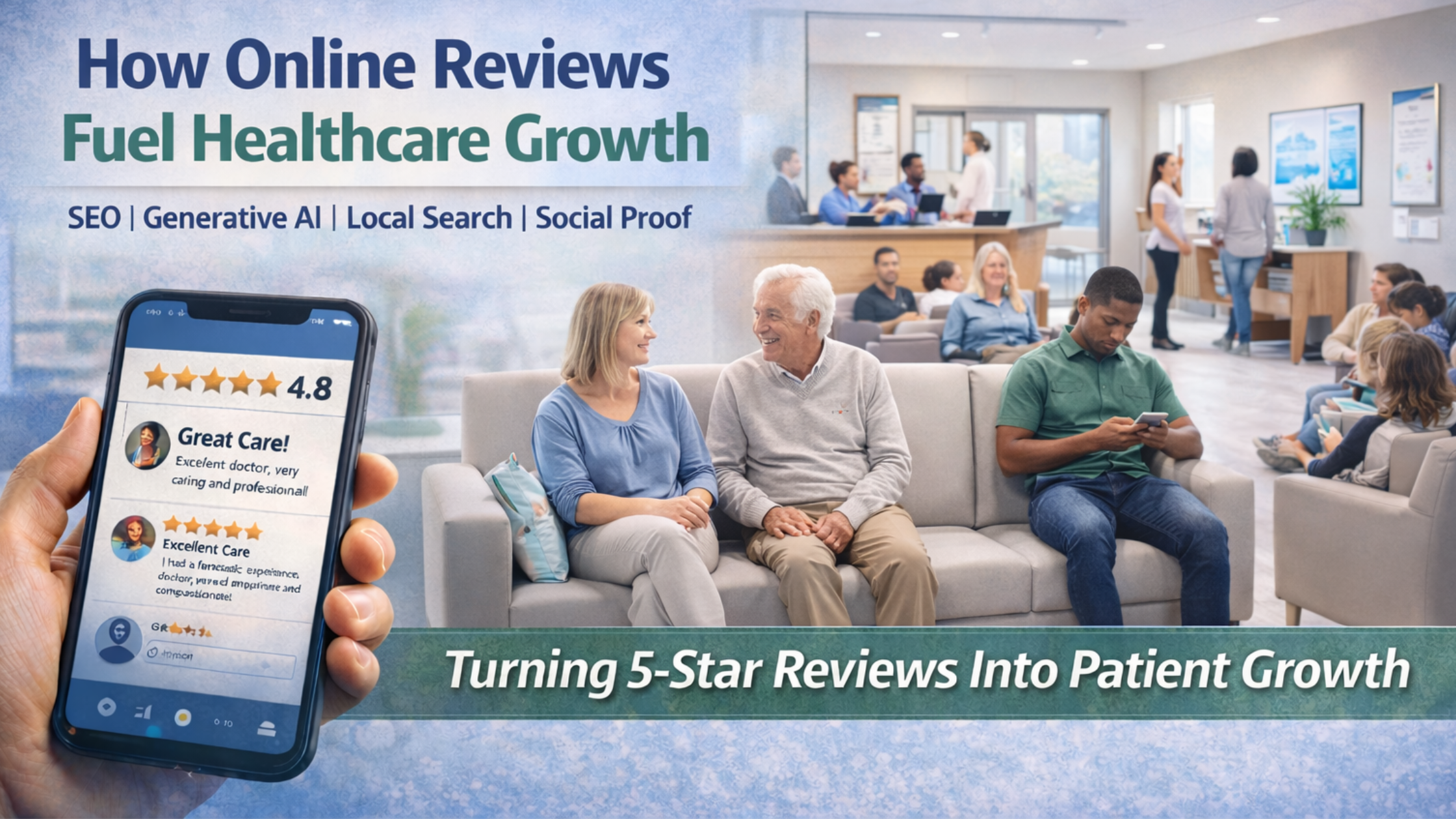
Online reviews in healthcare are not a passive reputation asset. They are an active growth tool that shapes search visibility, influences AI-driven recommendations, and reduces patient hesitation at every stage of the acquisition funnel. Patients increasingly use reviews as a shortcut for assessing safety, quality, and emotional fit before they ever evaluate a clinic’s website or credentials.
Moreso, search engines interpret reviews as third-party trust validation, in the high-risk, highly competitive healthcare vertical. Generative AI systems absorb them as corroborating evidence when recommending providers. Local search platforms use them to determine which practices surface first and most often.
Healthcare organizations that operationalize review collection, response not only protect their reputation, but they also gain a compounding advantage across visibility, trust, and patient acquisition.
What is often underappreciated is that reviews shorten the decision cycle. When trust is established before a first click or call, prospective patients move faster from discovery to action, require less reassurance from on-site content, and are less likely to comparison-shop across multiple providers. In healthcare, that reduction in friction translates directly into higher-quality inquiries, stronger conversion rates, and more efficient patient acquisition over time.
This article examines how patient reviews directly power four interconnected growth pillars: organic search visibility, Generative Engine Optimization (GEO), local search performance, and social proof–driven conversion.
How Patient Reviews Impact Healthcare SEO
Search engines classify healthcare as a Your Money Your Life category, meaning ranking systems apply stricter quality and trust thresholds than in most other verticals. Within this framework, reviews function as external validation of real-world experience. They help algorithms determine which providers are credible, relevant, and actively serving patients.
Google’s own guidance on the shift from E-A-T to Experience, Expertise, Authoritativeness, and Trustworthiness is worth referencing directly because it clarifies why reputation signals matter more in sensitive categories like healthcare. See Google’s official guidance introducing E-E-A-T.
Platforms like Google use review volume, recency, and overall sentiment as indirect indicators of legitimacy and service quality. A clinic with hundreds of recent, detailed reviews presents a fundamentally different trust profile than one with a sparse or outdated review history. Over time, that difference supports stronger and more stable organic rankings, particularly during core updates where trust signals are reweighted. As AI-driven moderation systems mature, authenticity is becoming its own ranking layer. Google is increasingly using advanced models to analyze review patterns, semantics, and reviewer history to identify fake or AI-generated reviews at scale, which means verified, context-rich reviews tied to real encounters will carry disproportionate weight going forward.
From a growth perspective, this stability matters. Practices with consistent, authentic review activity are less vulnerable to volatility during algorithm updates because their trust signals are reinforced externally. Reviews act as a buffer, anchoring rankings to real-world experience rather than purely on-site optimization.
Reviews as Semantic and User Experience Fuel
Beyond trust, reviews expand a site’s semantic footprint in ways traditional keyword research cannot fully replicate. Patients describe symptoms, fears, diagnoses, and outcomes in everyday language, generating phrases that align closely with how real people search.
Clinical copy might reference “patellar tendinopathy.” Patients write that a provider “fixed my jumper’s knee so I could run again.” That unscripted language increases relevance for long-tail and conversational queries while improving perceived relevance for human readers.
There is also a behavioral layer. When reviews are surfaced through on-page integrations, review widgets, and structured data, they provide immediate, human-sounding proof at the moment of decision. For a deeper look, read Analyzing the Patient Sentiments in Healthcare Domain using Machine Learning.
Patients are looking for reassurance, relatability, and lived experience. Reviews function as narrative proof, validating not just clinical competence but bedside manner, communication quality, and emotional safety. These signals directly influence whether a visitor stays, engages, and converts.
Proactive marketing systems go further by storing first-party review data in structured form, using reviews schema, CRMs, and CDPs so that themes from reviews can inform website personalization, education sequences, and even the language used in paid campaigns.
Avoiding SEO and Compliance Pitfalls
The same systems that reward authentic reviews penalize manipulation. Google’s Business Profile policies explicitly prohibit fake, paid, gated, or misleading reviews, and practices that violate them risk long-term suppression. It’s the most important primary source for operators..
Regulatory scrutiny also matters. The Federal Trade Commission has made it clear that undisclosed incentives, deceptive solicitation practices, and review manipulation can violate truth-in-advertising expectations, as outlined in its guide “Soliciting and Paying for Online Reviews: A Guide for Marketers.” In healthcare, compliance risk is amplified by privacy obligations. Public responses must never disclose protected health information, confirm patient status, or reference diagnoses, even if the reviewer volunteered details. This is why review response training is not “reputation management.” It is risk management.
This is why review response strategy is a risk-management function. Response timing, tone, and consistency signal professionalism to patients while demonstrating policy compliance to platforms. Neutral, empathetic acknowledgments that avoid confirmation of care can still communicate accountability and compassion without exposing the organization to regulatory risk.
Generative Engine Optimization: Reviews in AI-Driven Answers
Patients increasingly ask tools like ChatGPT, Gemini, and Perplexity to recommend providers, compare clinics, or interpret treatment options. These systems do not retrieve a single page. They synthesize patterns across the web and are guided by Google’s broader stance on AI-generated content and as mentioned earlier, on E‑E‑A‑T, which emphasizes original, high‑quality, experience-backed information.
That means reviews now influence AI visibility in a way that resembles how they already influence local and organic visibility: not as a direct ranking factor inside an AI model, but as a high-signal input across the ecosystem those models learn from. Provider reviews are foundational to discovery and choice behavior.
When a clinic consistently appears with strong sentiment and clear specialization across major platforms, it becomes statistically more likely to be associated with relevant recommendation-style queries. That association strengthens when patients repeatedly mention specific conditions and outcomes in reviews. In practical terms, repetition trains perception. If dozens of patients independently connect your brand to “pelvic pain” or “fertility care,” that consistency becomes part of the public knowledge graph surrounding your practice.
As AI modes in search consolidate and summarize consumer experiences, reviews that are specific, recent, and authentic are more likely to be surfaced, while synthetic or low-value reviews are filtered out by increasingly sophisticated detection systems.
Local SEO: Reviews as the Engine of Map Pack Visibility
For most healthcare providers, the first digital touchpoint is not the homepage. It is the Google Business Profile result in local search and maps.
Local ranking is often described through relevance, distance, and prominence, and reviews are a central input into prominence. In practice, a 4.7–4.8-star profile with frequent new reviews often outperforms a perfect 5.0 profile that has been inactive for months. Ongoing activity signals an engaged, thriving practice, and local systems tend to reward that.
Reviews also shape what patients do after they see you. Higher review counts and stronger sentiment increase the likelihood of taps on “Call,” “Directions,” or “Website.” Just as important, prospects often read how a practice responds to criticism as a proxy for professionalism, communication style, and empathy.
Reviews as Healthcare Growth Infrastructure
Online reviews are no longer confined to reputation management or local SEO. They operate as a cross-system trust signal that influences search rankings, AI-driven recommendations, patient confidence, and conversion behavior simultaneously.
Healthcare organizations that treat reviews as infrastructure rather than a marketing afterthought build a durable advantage. They earn visibility that compounds, trust that travels across platforms, and patient relationships that begin with confidence rather than hesitation. As search, AI, and consumer behavior continue to converge, reviews will increasingly determine not just who is seen, but who is chosen.
SunHouse Marketing helps healthcare organizations operationalize reviews across SEO, local search, and AI-driven discovery in a way that is compliant, scalable, and measurable.
You can learn more about our healthcare growth approach or request an introductory discussion.