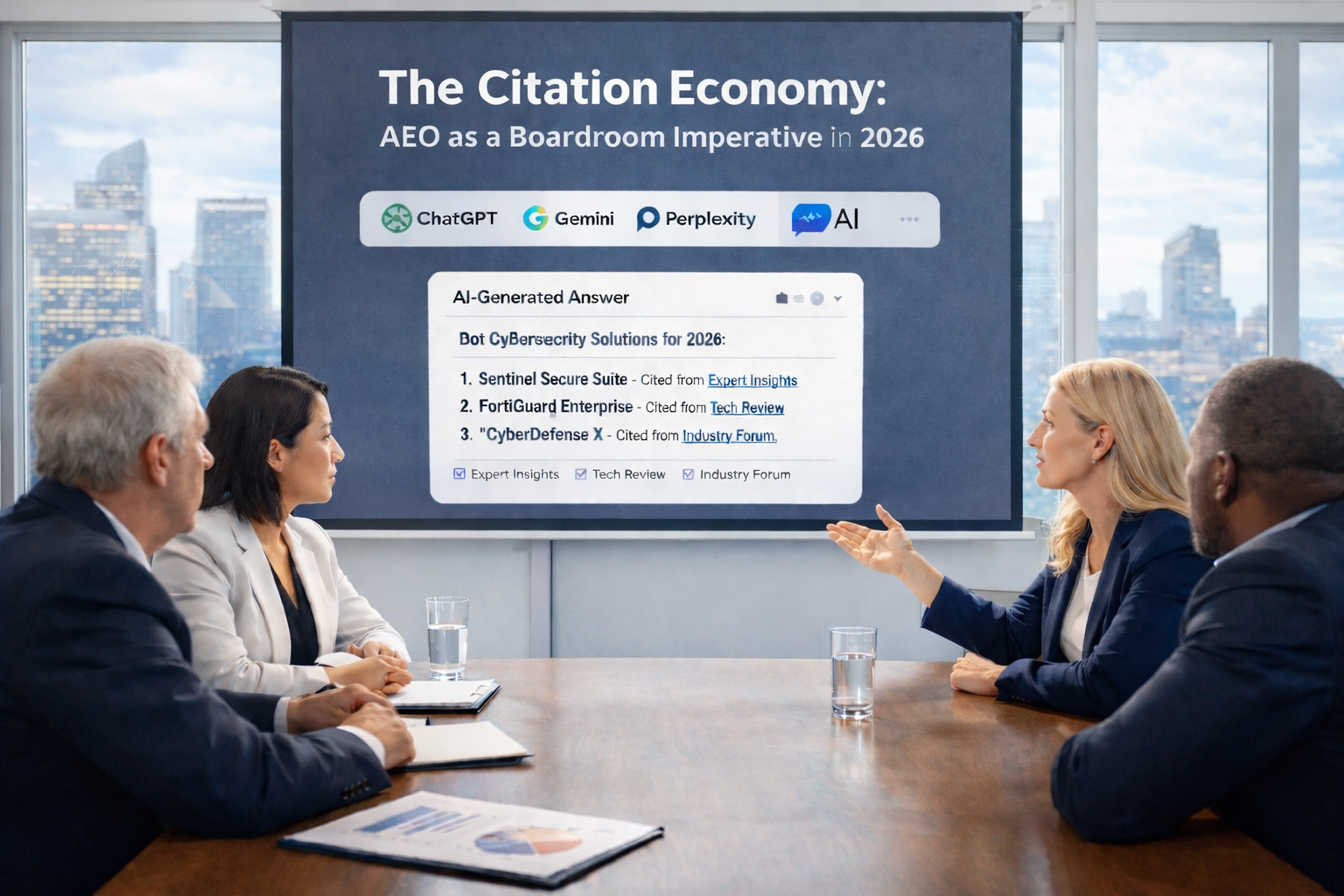
There is a conversation happening in executive meetings everywhere right now and it sounds like this:
“Our rankings are stable. We are doing everything right with our SEO. Why is our organic traffic declining?”
There is a fundamental structural change in Search behavior. Users have migrated into conversational, AI-mediated environments. Today’s buyers are asking complex, multi-part questions inside their favorite generative AI platform. These interfaces return synthesized, direct answers as opposed to lists of links. Increasingly, the buying decision is influenced before a click ever occurs.
A massive redistribution of visibility, companies that understand this shift are investing in Answer Engine Optimization (AEO) as a critical business investment.
Winning in this new environment means understanding how AI actually retrieves data and executing a strategy that forces these models to cite your brand first.
How AI Builds Answers: Why Trust Signals Matter
In the context of AI search, Information Retrieval (IR) is the underlying process a system uses to understand a buyer’s query, locate the most relevant data, and present it back to them. While traditional IR functioned like a digital index card system, matching exact keyword strings to return a list of blue links, AI-driven IR relies on semantic retrieval. Instead of looking for matching words, the AI translates the buyer’s complex question into mathematical concepts to hunt for the actual meaning and intent behind the query, extracting fact-dense chunks of information from various sources to synthesize a single, custom-written answer.
The underlying architecture of search has officially flipped. Modern information retrieval is now dictated by conversational modules. Instead of matching keywords, these systems actively rewrite user prompts, expand context, and retrieve semantically dense content. As highlighted in 2026 industry analyses, such as Paperguide.ai’s breakdown of specialized search environments, even the most complex, highly technical B2B queries are now processed and answered directly by AI synthesis.
The business implications of this shift are immediate and structural. Because AI systems retrieve information semantically rather than by exact keyword matches, your company, whether you operate a corporate law firm, a healthcare network, or a managed IT service, will only surface if your content directly addresses real buyer intent, regardless of the phrasing used. Furthermore, context persists across multi-turn conversations. A buyer might start by asking an AI about baseline managed IT pricing, then seamlessly follow up with, “How does that scale for a 50-person SaaS company?” The engine remembers the parameters and refines its answer. Most importantly, generative AI synthesizes answers from fragments. It might extract a concise explanation of your onboarding process from your website, cross-reference it with a client testimonial on Google , and inject a competitive comparison from an industry forum to assemble a single, definitive recommendation. In this environment, structural clarity and a consistent, authoritative narrative across your entire digital footprint matter more than ever.
Behind the scenes, the technology relies on hybrid search models and Retrieval-Augmented Generation (RAG). As technical overviews from Graspur, Milvus, and Vectorize.io explain, your content is converted into mathematical representations of meaning (embeddings).
Visibility now depends on machine interpretability.
The Architecture of AEO: 3 Structural Pillars
To dominate AI-generated responses, your content must be fundamentally restructured around how machines read and extract data.
1. Topic-Centric Information Architecture
Guidance from authoritative industry publications like Search Engine Land reinforces a critical shift: businesses must move away from isolated keyword pages and build entity-rich, topic-clustered content. AI systems interpret the relationships between concepts, not just text strings.
Effective AEO content organizes information around buyer decisions and problems, explicitly defining concepts and using related terminology naturally. This requires restructuring your digital presence around decision pathways rather than search volumes.
2. Structured Authoring for Extraction
Conversational search behavior shows that AI systems prefer to extract concise, self-contained answers. You must adopt the “50-Word Rule.” Each major section on your site should begin with a natural language question (e.g., “What are the integration limits of our software?”), immediately followed by a direct, 40-to-60-word answer. You can fan out into deeper explanations below, but that initial, fact-dense block is what the AI will extract and cite.
3. Structured Data and Entity Consistency
Technical documentation from Google Search Central and leading developer hubs emphasizes that standardized schemas are essential for Natural Language Processing (NLP) systems. Schema is no longer an optional SEO bonus; it is the translation layer between your business and a Large Language Model (LLM).
By consistently using Organization, Product, Article, and FAQPage schema markup across your site, you remove all ambiguity. You are explicitly telling the AI: “Here is our exact pricing, and here are our core features.”
GEO Beyond Your Website: Trust, Media, and AI Crawlers
If you only restructure your website, you are only doing half the job. In 2026, AI visibility requires a much broader ecosystem approach.
The Off-Page Trust Ecosystem
Your website is no longer the sole source of truth; it is just the starting point. LLMs are highly skeptical and deeply reliant on third-party validation. As widely reported by business media like Forbes and Bloomberg regarding major AI data-licensing deals, AI platforms heavily rely on User-Generated Content (UGC) from platforms like Reddit and established industry forums to validate claims and build “trust profiles.” If your product page claims your service is the fastest on the market, but an industry forum disagrees, the AI will synthesize the consensus, not your marketing copy. AEO requires a ubiquitous digital footprint; you must influence the narrative everywhere your brand is discussed.
Multi-Modal and Visual Retrieval
Assuming AI only retrieves text is a critical blind spot. With the rollout of models like Google’s Gemini, search has become deeply multi-modal. As covered extensively by TechCrunch, modern AI engines synthesize text, images, charts, and video simultaneously.
If a buyer asks an AI to compare manufacturing workflows, the engine won’t just generate a text summary; it will pull a well-structured diagram or a timestamped YouTube explainer directly into the response. To dominate AI Overviews, you must invest in utility-driven visual assets paired with highly descriptive alt-text and transcripts.
The Executive Crawler Dilemma
Then there is the governance conversation happening in boardrooms right now: Do we let the bots in? Throughout recent months, mainstream media outlets like Forbes and Bloomberg regarding major AI data-licensing deals, AI platforms heavily rely on User-Generated Content (UGC) from platforms like Reddit and established industry forums to validate claims and build “trust profiles.” If your product page claims your software is the fastest on the market, but developers on an industry forum disagree, the AI will synthesize the consensus, not your marketing copy. GEO requires a ubiquitous digital footprint; you must influence the narrative everywhere your brand is discussed.
New KPI Stack
Finally, you cannot optimize what you cannot measure. Traffic attribution has fundamentally shifted. To track this, growth teams are integrating AI visibility metrics into their analytics to measure “Prompt Visibility” and “AI Share of Voice.” Your company needs a competent way to track how often you are cited in language learning models.
Two Layers of Visibility
Conversational AI systems reward structural clarity, entity consistency, and authoritative, extractable answers.
Digital visibility now exists in two distinct layers: Traditional Ranking visibility and Answer visibility.
Answer Engine Optimization ensures that when AI systems shape the first impression of your brand, they are drawing from your expertise, not someone else’s summary of it. Companies must shift from “How are we ranking?” to “How are we being represented in AI-generated answers?” That is a materially different strategic discussion. And it is one that belongs at the leadership table.
AEO Readiness Checklist
The competitive risk is exclusion from AI-mediated answers. Hand this diagnostic framework directly to your marketing or growth team to evaluate your current standing:
Strategic Foundation
[ ] Do we know which AI systems currently surface answers in our category?
[ ] Have we documented how those systems describe our company versus competitors?
[ ] Is our content architecture built around decision-stage topics rather than keyword silos?
Content & Technical Structure
[ ] Do key pages include clear, question-based headings aligned with buyer prompts?
[ ] Are concise, standalone answers (40-60 words) present immediately under those headings?
[ ] Is structured data (Organization, Product, FAQPage) validated and consistent?
[ ] Are we utilizing descriptive, utility-driven visual assets (charts/videos) for multi-modal retrieval?
Governance & Measurement
[ ] Have we audited our robots.txt file to ensure we aren’t accidentally blocking critical AI crawlers?
[ ] Are we tracking “Prompt Visibility” and AI citations alongside traditional rankings?