I’ve been writing about and sharing the tools behind SunHouse for years. Our first full agency-stack roundup appeared in 2021, followed by updated lists in 2023 and 2024 as new platforms earned their place and others dropped out of rotation.
The 2026 stack looks very different. AI is now embedded across research, strategy, writing, advertising, automation, analysis, and production. Search has also become a more integrated discipline, with SEO, GEO, AI visibility, content authority, local search, and structured information increasingly working together. That shift matters because discovery is increasingly happening without a traditional click. A June 2026 SparkToro analysis of Similarweb data found that 68.01% of U.S. Google searches ended without a click in the first four months of 2026, up from 60.45% in 2024.
At the same time, I do not see GEO as a replacement for SEO. Google’s guidance says that the same foundational SEO practices remain relevant for generative AI search, including technical clarity, crawlability, useful original content, strong page experience, and structured data that accurately reflects what is visible on the page. For agencies, the implication is practical: the stack increasingly has to support visibility, authority, attribution, and execution across both traditional search and AI-generated discovery.
This roundup focuses on the tools behind our digital marketing and lead generation services, and how we use them to research opportunities, make decisions and carry out the work.
These are my own working subscriptions and our team’s client tools. Feature availability and usage limits vary by plan and rollout. Some tools are part of our daily workflow, some are used weekly, and others come in for specific projects or client needs. Frequency reflects usage, not importance. Tools have to earn their place. We test new platforms regularly, keep the ones that materially improve the work, and drop the ones that do not.
Reviewed October 9, 2026. I am a Semrush Ambassador. Some links in this article are affiliate or referral links.
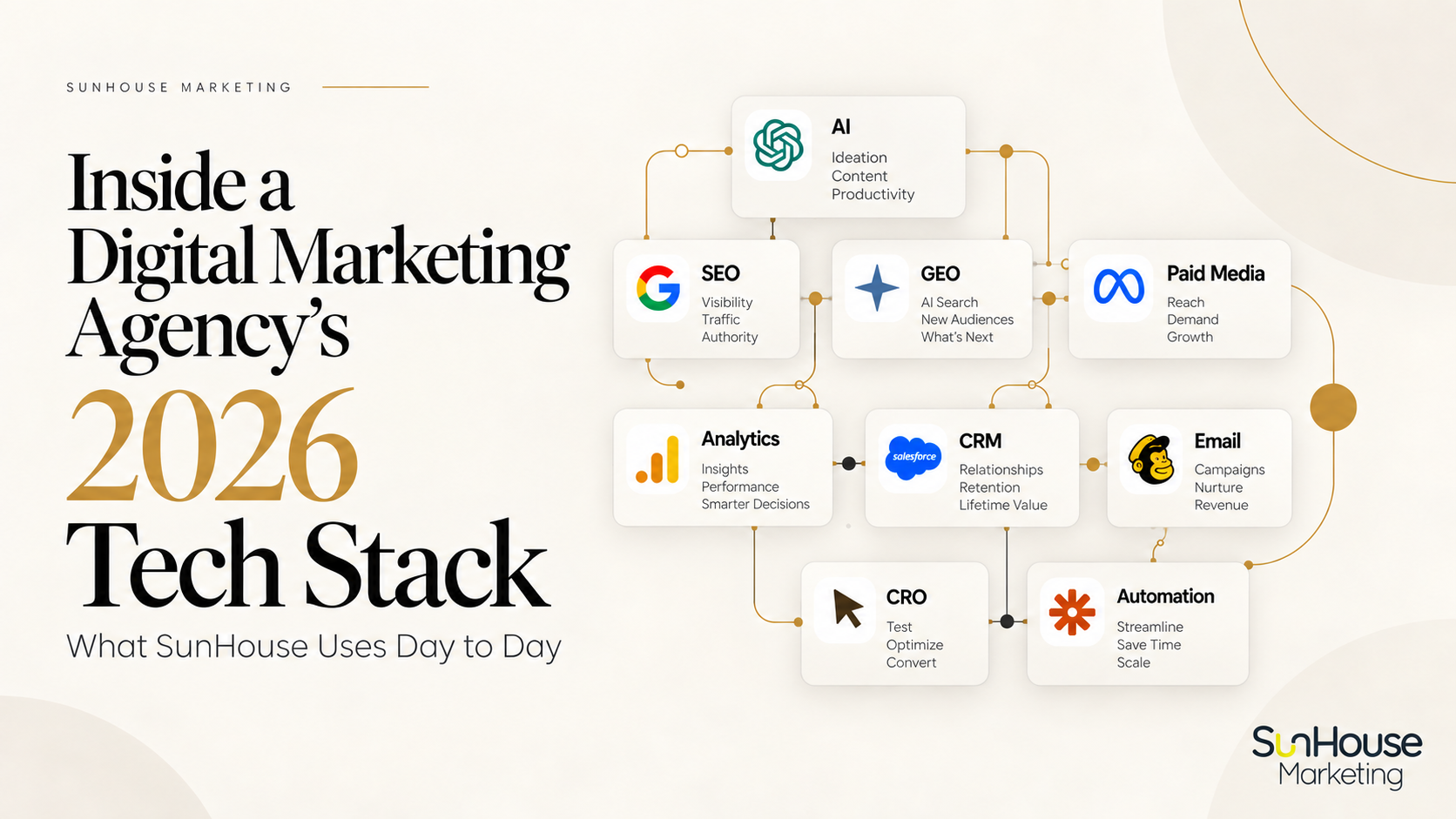
The tools are grouped by function, in the same order as the sections below. Frequency reflects our current usage; tools being phased out are marked separately.
| Tool | Primary Use | Frequency |
|---|---|---|
| AI, Research and Automation | ||
| Claude Max | Strategy, research, agentic workflows and design | Daily |
| ChatGPT Plus | Writing, analysis and critical review | Daily |
| Perplexity | Sourced research and verification | Regular Rotation |
| Composio | Connections between AI and business systems | Regular Rotation |
| Tavily | Live search and source retrieval | Regular Rotation |
| GitHub | Technical investigation | Specialist |
| Fyxer | Email triage and inbox management | Daily |
| Zapier | Workflow automation and lead routing | Daily |
| Claude Code | Desktop implementation, websites, tracking and automation | New / Early Rollout |
| SEO, GEO and Local Search | ||
| Semrush | SEO, GEO, local SEO and competitive intelligence | Daily |
| Google Business Profile | Local SEO and profile management | Regular Rotation |
| BrightLocal | Local rank tracking, citations and reputation | Specialist |
| Paid Media and Creative Testing | ||
| Google Ads | Paid search and performance marketing | Daily |
| Meta Ads Manager | Paid social advertising | Daily |
| LinkedIn Ads | B2B advertising and lead generation | Weekly |
| Microsoft Advertising | Paid search | Weekly |
| Ryze AI | Paid media optimization | Daily |
| AdCreative.ai | Creative testing and ad production | Daily |
| Analytics, Attribution and Reporting | ||
| Google Analytics 4 | Analytics and conversion behavior | Weekly |
| Google Search Console | Search performance and indexing diagnostics | Weekly |
| Google Tag Manager | Tracking and event implementation | Regular Rotation |
| CallRail | Call attribution and lead tracking | Daily |
| Data Studio (formerly Looker Studio) | Reporting and dashboards | Phasing Out |
| Landing Pages and Conversion Optimization | ||
| Unbounce | Landing pages and CRO | Daily |
| Contentsquare (formerly Hotjar) | Heatmaps and session recordings | Specialist |
| VWO / Wingify | A/B testing and experimentation | Specialist |
| CRM, Email and Lifecycle Marketing | ||
| Salesforce | CRM and attribution | Regular Rotation |
| Zoho CRM | CRM and lead management | Regular Rotation |
| Zoho Campaigns | Email campaigns and follow-up | Regular Rotation |
| Zoho Marketing Automation | Lifecycle marketing and automation | Regular Rotation |
| ActiveCampaign | Lifecycle marketing and automation | Regular Rotation |
| Klaviyo | Shopify lifecycle and retention marketing | Platform-Specific |
| NeverBounce | Email verification and list hygiene | Specialist |
| Creative Production and Collaboration | ||
| Canva | Creative production | Daily |
| Midjourney | High-end image generation | Specialist |
| Metricool | Social scheduling and management | Regular Rotation |
| Google Workspace | Agency collaboration and documentation | Daily |
AI, Research and Automation
Claude
Daily: Strategy, research, analysis, delegated workflows and design.
I pay for a Claude Max subscription, which is the account behind the Claude workflows described here. Claude is at the center of much of my AI work. Each ongoing client or initiative gets its own Project, with instructions, source material, positioning, audience, terminology and business rules. I also define the methodology, source hierarchy, verification requirements and expected deliverable. That preparation makes the analysis more useful from the beginning.
Collaboration, Delegated Work, Design and Code
I use Claude both for active collaboration, such as working through strategy or refining writing, and for delegated tasks involving files, multiple documents, administrative work or longer research. Anthropic has merged chat and the capabilities previously called Cowork into one Claude experience, with a phased rollout. I still choose how closely to work through a task, define the objective and review the result.
Claude Design has been particularly useful for presentation concepts, one-pagers, layouts and prototypes. I can work from a reference design, make broad changes through chat and give targeted feedback on individual elements. The value is being able to keep refining both the content and the visual hierarchy.
I have just started using Claude Code on desktop, where marketing overlaps with websites, tracking and automation. I have an Elementor MCP account and a daily dashboard, and I am planning further workflows for SunHouse. My focus includes technical investigation, prototyping and translating marketing requirements into implementation. This is an early rollout, and I distinguish what is already in use from what I am still planning.
Connectors, Skills and Repeatable Workflows
Connectors bring selected current data into the analysis without repeated exports. Skills help formalize recurring methodologies for audits, research and deliverables. A Project supplies business context; a Skill defines the process for a recurring task.
Composio extends the connections available to Claude. Depending on the project and permissions, that can include GA4, Search Console, advertising data and CRM records. I also use Tavily for live research and source retrieval, and GitHub for repository and development context.
The useful connection is the one that improves a decision or removes unnecessary manual work. Access to a system does not, by itself, make the analysis reliable. I still check the account, date range, source and interpretation.
Building an Operating Workflow
I have also been developing a Claude-supported operating workflow for SunHouse: a shared task tracker, a priorities dashboard and scheduled briefing work. The structure includes a Chief of Staff role and specialist roles for business development, search visibility, content, paid media and client operations.
This remains a developing system. Some workflows have been tested; other roles are still being defined and connected. I distinguish a role with written instructions from a process that has actually run and produced a reviewed result. The objective is to make priorities, ownership and follow-through easier to manage.
Turning the Analysis Into a Usable Artifact
Another important part of my workflow is turning the final analysis into a usable artifact.
That artifact might be a structured report, visual brief, wireframe, annotated recommendation, implementation document, presentation, or another format designed around the person who needs to take the work forward.
For example, I recently completed a CRO review of a client’s website. I am not the designer responsible for rebuilding the pages, so the useful endpoint was not a long conversation explaining what I thought should change. I turned the findings into artifacts the designer could work from, with the recommendations organized and translated into a clearer implementation brief.
I apply the same principle elsewhere. Strategy should become something a team can execute, research should become something a client can understand, and analysis should be translated into a format that a designer, developer, media buyer, copywriter, or project manager can actually use.
For me, that is an important distinction in using AI well: the final output should be designed for the person who needs to act on it, not for the AI conversation that produced it.
The principle behind all of this is simple: context before prompting. The better the model understands the business, the evidence, the constraints, and the process, the stronger and more useful the output becomes.
ChatGPT
DAILY
Writing · Analysis · Research · Critical Review · Problem-Solving
I pay for a ChatGPT Plus subscription. ChatGPT is another daily working environment for me, and it currently supports most of my writing projects. While Claude has become the broader operating environment for much of my AI work, ChatGPT has become particularly important for writing because I have spent a great deal of time refining the overall voice.
Over time, I have been very deliberate about teaching it what good writing sounds like to me: natural rather than formulaic, authoritative without becoming stiff, conversational where appropriate, and free of many of the patterns that make AI-generated copy immediately recognizable. I have also defined the language, structures, phrasing, and habits I want it to avoid.
For many writing assignments, ChatGPT now gives me a stronger starting point because the underlying voice is already much closer to what I want. I still edit and challenge the work, but I spend less time stripping away generic AI language before I can get to the substance.
Projects and Context
As with Claude, I do not use ChatGPT as one undifferentiated stream of conversations. Any ongoing client, initiative, research stream, or substantial body of work gets its own Project.
Each Project has its own instructions and relevant background material so the model does not have to reconstruct the business from individual prompts. Those instructions typically establish the client’s positioning and audience, brand voice, strategic assumptions, marketing terminology, writing standards, constraints, evidence requirements, preferred structure, and anything I specifically want challenged rather than simply accepted.
The broader writing voice provides consistency across my work, while the Project instructions add the context that is specific to the client. That allows a healthcare organization, B2B company, ecommerce business, nonprofit, and SunHouse itself to sound distinct without starting from scratch every time.
I also provide source documents, previous work, research, client materials, and other relevant context when they improve the assignment. As with Claude, I would rather give the model the information it needs than allow it to fill important gaps by inference.
Writing and Iteration
I use ChatGPT throughout the writing process, not simply to generate a first draft.
Sometimes that means helping me organize an argument before I write. Other times I may bring in a rough draft, dictated thoughts, research, client feedback, or an existing piece and work through it iteratively.
A large part of the value is the back-and-forth. I can challenge a sentence, explain why something does not sound like me, ask for a stronger marketing argument, question whether a paragraph is strategically sound, or keep refining until the language and thinking are both where they need to be.
My instructions, examples and retained context help keep subsequent drafts closer to the voice I want. I do not simply accept or reject an output. I explain what is wrong with it and what I would do differently, which makes the working environment more useful over time.
Critical Review and Second Opinions
ChatGPT also plays an important role as a critical second opinion.
I regularly bring it strategies, drafts, recommendations, research findings, and analyses developed elsewhere and ask it to pressure-test the thinking. Rather than asking a series of disconnected questions, I want it to examine the reasoning as a whole: identify weak assumptions, find gaps, consider credible counterarguments, question whether the evidence actually supports the conclusion, and point out what an experienced specialist might challenge.
I use Claude in the same way, often taking work from one environment into the other.
Agreement between two models is not independent verification. For important decisions, I check the evidence rather than treating the first AI response as the answer. I compare perspectives, introduce opposing arguments, add evidence, and keep refining the reasoning until I am comfortable using it to support an actual marketing recommendation.
That is an important part of how I use AI generally. The value is not simply producing content faster. It is having another sophisticated layer of writing, analysis, and critique available throughout the work.
Perplexity
REGULAR ROTATION
Sourced Research · Source Discovery · Verification
Perplexity is my first choice when the quality of the research and the sources behind it matter.
In my own workflow, it consistently does a better job of finding strong, relevant source material and giving me a clear trail of citations to work from. That makes it particularly useful when I am researching a market, validating a claim, looking for original studies or data, investigating competitors, or building the research foundation for a strategy or article.
I tend to use ChatGPT and Claude differently. They are often stronger environments for thinking through the research, challenging it, synthesizing multiple sources, and ultimately turning it into strategy or writing. But when my immediate question is “Where is the strongest evidence for this?”, I usually start with Perplexity.
That does not mean I accept its citations at face value. An AI-generated answer is not the source, and the presence of a citation does not guarantee that the source actually supports the claim being made. I still open the underlying material, check how current and authoritative it is, look for the original source where possible, and distinguish primary research from secondary articles repeating someone else’s findings.
For research-heavy work, that source trail is one of the main reasons Perplexity continues to earn a place in my stack.
Fyxer
DAILY
Email Triage · Inbox Management
Fyxer helps manage part of the administrative layer around email.
The value is less about email itself and more about protecting senior time from routine inbox management so more attention can go toward strategy, clients, and decision-making.
Zapier
DAILY
Workflow Automation · Lead Routing · Data Movement
Zapier is one of the connective pieces of the SunHouse stack.
We use it when two systems need to communicate but the workflow is not available natively.
That might involve:
- Passing a lead into a CRM
- Triggering an email sequence
- Creating a task
- Sending an internal notification
- Moving campaign data
- Updating customer information
- Connecting a form with another application
- Routing information based on specific conditions
The best automations are often the least glamorous ones: repetitive manual work that should never have required a person in the first place.
But automation also needs safeguards.
We think about duplicates, incomplete data, failed steps, attribution fields, conditional logic, and what happens when the expected workflow breaks.
Automating a bad process simply creates mistakes more efficiently.
SEO, GEO, Local SEO, and AEO
Semrush
DAILY
SEO · Competitive Intelligence · GEO/AEO · Content Strategy
Semrush is one of the most heavily used tools in our search stack.
I use it for:
- Keyword research
- Competitive analysis
- Backlinks
- Rankings
- Content gaps
- Technical SEO
- Search visibility
- Competitor traffic analysis
- Content opportunities
- AI visibility research
I make an important distinction between Semrush data and first-party data. Semrush gives us large-scale modeled data about a market, keywords, competitors, rankings, backlinks, and traffic. Google Search Console and GA4 report on the client’s own digital properties, within the limits of their tracking, attribution and reporting coverage.
Both are valuable, but they answer different questions.
I also connect Semrush directly into Claude through its MCP integration where appropriate. That changes the workflow considerably. We can increasingly bring current marketing data directly into the environment where the analysis is happening.
For GEO and AEO, I use Semrush and other research sources to examine questions such as:
- Which brands are appearing in AI-generated answers?
- Which competitors are being mentioned instead of the client?
- Which sources are being cited?
- Which pages are earning citations?
- Which questions is the brand failing to answer?
- Where is authoritative content missing?
- Which third-party sources influence the answer ecosystem?
- Is the brand’s entity information clear and consistent?
- Which existing pages should be expanded or restructured?
That research informs our SEO and AI visibility work, including content priorities, internal architecture and authority building.
One practical implication is that I am increasingly focused on whether search engines and AI systems can clearly understand who a brand is, what it is authoritative about, and where that authority is corroborated. Entity clarity, topical depth, internal architecture, structured data, and credible third-party mentions all contribute to that picture. I am much less interested in supposed GEO hacks that sit outside the fundamentals. Google’s current guidance explicitly says that websites do not need special AI text files or AI-specific markup to appear in Google’s generative search features.
There are also practitioner case studies worth examining. Search Engine Land documented its own 2026 case study showing gains in organic visibility and AI Overview citations after strengthening topical authority and Knowledge Graph/entity optimization. The author co-created TopicalBoost, the product evaluated, so I treat this as a disclosed practitioner case study rather than independent validation.
Google Business Profile
REGULAR ROTATION
Local SEO · Maps Visibility · Reviews · Local Presence
For local clients, we manage Google Business Profile directly. That includes keeping core business information accurate, reviewing categories and services, managing photos and updates, monitoring reviews, and making sure the profile supports the broader local SEO strategy.
Semrush remains our primary local SEO research and monitoring tool, while Google Business Profile is where much of the actual local presence is managed.
SPECIALIST
Local SEO · Reputation · Local Search Visibility
I have used BrightLocal occasionally for clients where local reputation and local-search performance are especially important. It provides useful local rank tracking, citation, reputation, and Google Business Profile-related capabilities, although it remains a specialist option rather than a core part of our stack.
Paid Media and Creative Testing
Google Ads, Meta Ads, LinkedIn Ads and Microsoft Advertising
These platforms support different audiences and buying situations. We choose channels around the offer, the customer and the economics of acquiring a qualified lead. Campaign decisions need conversion data and sales feedback, as well as clicks and platform-reported results.
Ryze AI adds an optimization layer, while AdCreative.ai supports creative production and testing. I evaluate recommendations against the account context and business objective. Our paid media work includes the offer, landing page and measurement needed to judge whether a campaign is producing useful demand.
I have also been testing ChatGPT Ads for SunHouse. It is an experiment in a developing discovery channel, with results assessed separately from established client acquisition channels.
Analytics, Attribution and Reporting
GA4, Search Console, Tag Manager, CallRail and Custom Dashboards
GA4 helps us examine acquisition and conversion behavior. Search Console shows search queries, page performance and indexing information. Tag Manager supports event implementation, and CallRail adds call attribution. I am planning to phase out Data Studio (formerly Looker Studio) and build my own dashboards. That transition is planned rather than complete.
A form submission, a qualified inquiry and a customer are different outcomes. CRM records and sales feedback help connect marketing reporting to what happens after the initial conversion.
Landing Pages and Conversion Optimization
Unbounce, Contentsquare (formerly Hotjar) and VWO / Wingify
Unbounce supports landing page production and iteration. Contentsquare (formerly Hotjar) helps investigate visitor behavior, while VWO / Wingify supports structured experimentation where the traffic and test conditions justify it. We use the combination appropriate to the client and question.
A recent website CRO review illustrates how this work fits together. I developed recommendations on the consultation offer, copy and form placement, then organized those findings into a brief for the designer. Our conversion rate optimization work needs to leave the person implementing it with clear priorities and actionable recommendations.
CRM, Email and Lifecycle Marketing
Salesforce, Zoho and Email Platforms
Salesforce and Zoho CRM supply customer and sales context. Email and automation work may use Zoho Campaigns, Zoho Marketing Automation, ActiveCampaign or Klaviyo, depending on the client’s existing systems and requirements. Zoho Campaigns and Zoho Marketing Automation are separate products.
One practical application is separating contacts who have never visited, visited without purchasing, and already purchased. Each group needs different follow-up. Another is distinguishing past customers, older inquiries and opportunities that did not close. The work involves segmentation, copy, timing, CRM fields and checking whether the sequence produces a response.
NeverBounce supports list hygiene. Zapier connects steps where native integrations do not cover the process. We still need to check consent, deliverability, duplicate records and failed automations.
Creative Production and Collaboration
Canva, Midjourney, Metricool and Google Workspace
Canva supports creative production, Midjourney comes in for selected image-generation work, and Metricool supports social scheduling and management. Google Workspace remains part of day-to-day documentation and collaboration. AI-generated visuals still need review for brand fit and suitability.
How the Stack Supports Marketing Leadership and Execution
In my fractional CMO work, I use these systems to decide what deserves attention, what evidence is missing and what the team should do next. That includes setting priorities, defining measurement and reviewing execution with the people responsible for delivery.
Through SunHouse’s agency services, our team carries out the campaigns, content, tracking, conversion improvements and lifecycle marketing those decisions require. The tools help connect the work; the recommendation still needs an owner, a reason and a way to evaluate the result.
If you are considering the right level of support, our guide to fractional CMO service models explains the available approaches. You can also speak with SunHouse about marketing leadership or implementation.