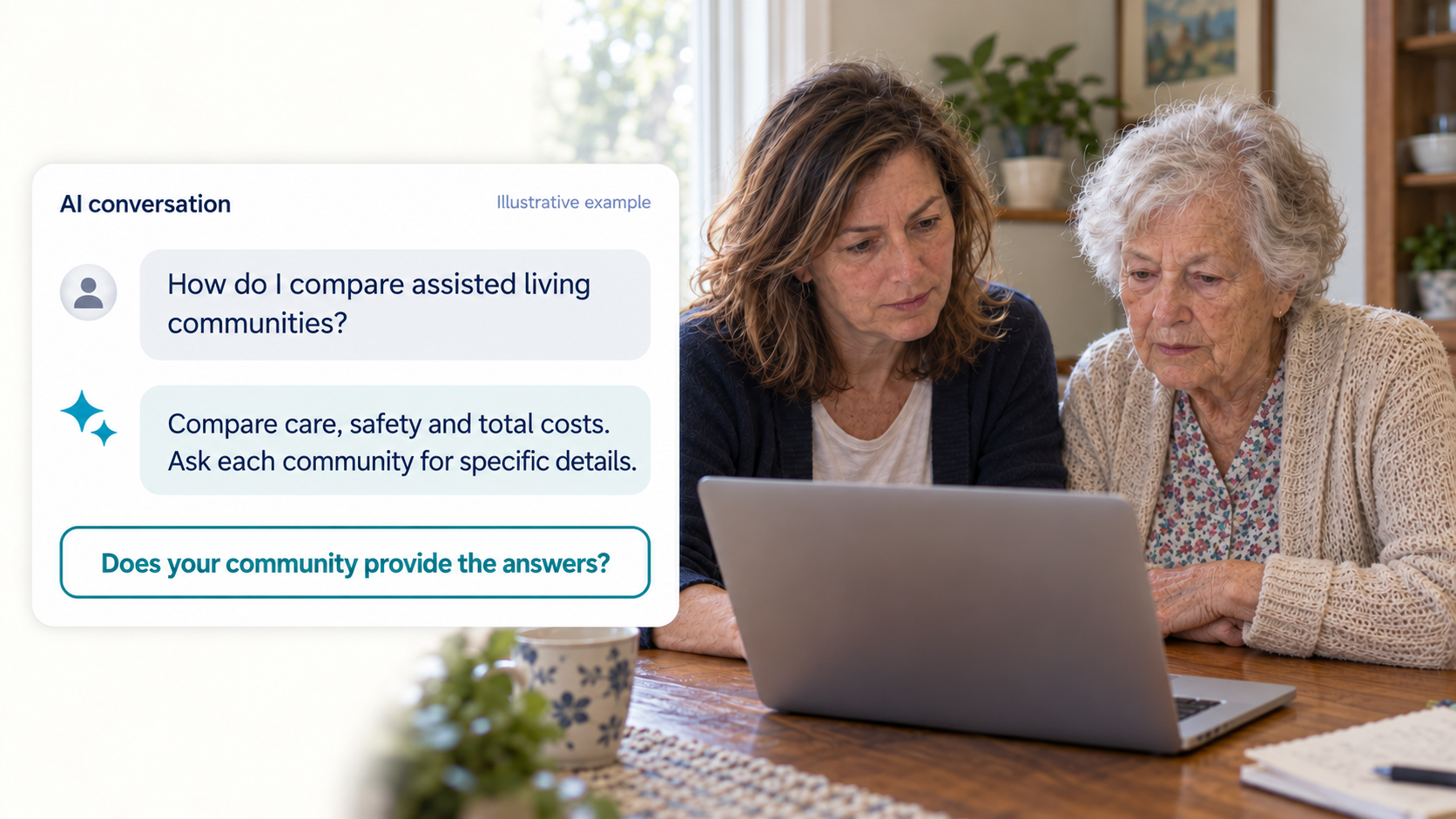
If you own an assisted living community or nursing home, being mentioned by ChatGPT is not the business goal. Helping the right families understand your care, speak with your admissions team, and make an informed decision is. Your website needs to support that process, whether someone finds you through Google, a referral, or an AI answer.
There is a limit to what the evidence tells us: the sources reviewed here do not establish how often families use ChatGPT to choose assisted living or nursing homes. That is not a reason to ignore AI search. It is a reason to keep your senior living marketing grounded in questions your admissions team actually hears, rather than claims about a trend nobody has measured.
Consider this example: a daughter wants to know whether her father can keep his own apartment while getting help with medication. Another family needs to understand the difference between a short rehabilitation stay and ongoing nursing care. Those are different decisions, and they should not lead to the same vague page about compassionate care.
I would organize the content around three decisions: care fit, confidence in the provider, and the financial and practical next steps. The questions below are illustrative, not a ranking of ChatGPT searches. The job of your content is to help a family recognize a good fit and understand what to do next.
Question One: What Kind of Place Does My Parent Need?
“Does my parent need assisted living or a nursing home?” is not just a topic for a blog post. It is a question about whether you can help. Answer it before asking someone to schedule a tour or discuss an admission.
The National Institute on Aging’s guide to residential care explains that assisted living serves people who need help with daily care, but not as much help as a nursing home provides. Nursing homes focus more on medical and nursing care. Assisted living services and arrangements vary by community and state, so your website should state what your own license and care team can provide. A description of medication assistance is not a promise of continuous skilled nursing.
For assisted living, explain daily support, medication assistance, assessment, and the point at which a resident needs care you cannot provide. For a nursing home, distinguish the services you actually offer, such as rehabilitation and ongoing nursing care, and explain the admission review. If you offer memory care, describe the program rather than relying on the label alone.
Have your clinical or care leadership review those descriptions. Marketing should make the service easier to understand, not stretch its boundaries to attract another inquiry. A call from a family you cannot safely serve is not a marketing win.
Question Two: Is It Safe, and Who Checks?
“How do you handle a fall?” asks for something more useful than “Our residents are our priority.” Explain who responds, how families are contacted, and how care plans are reviewed. Publish what your team actually does, with care leadership checking the details.
For assisted living, identify your state licensing agency and direct families to inspection or enforcement records where available. For Medicare-certified nursing homes, link to your facility’s listing on Medicare Care Compare, where families can review comparison information, including staffing and quality of care. These are different oversight systems; your website should not blur them.
The Administration for Community Living explains that state long-term care ombudsman programs help resolve concerns about residents’ health, safety, welfare, and rights in nursing homes, assisted living, and other residential settings. Make your own complaint process easy to find, alongside information about the state ombudsman. Inviting scrutiny is more credible than asking families to take your word for it.
Use outside evidence to explain a practice, not to decorate a claim. For example, the CDC’s STEADI-Rx guidance explains how some medications increase fall risk and why coordination between pharmacists and healthcare providers matters. That supports a discussion of medication review. It does not prove your facility prevents falls, and it is not a nationwide assisted living licensing rule.
Question Three: What Does It Cost, and What Happens Next?
You do not have to publish a personalized quote to explain how charges work. The National Institute on Aging guide cited above notes that assisted living residents can pay more for extra services or special care. Explain your base services, what triggers additional charges, and how an assessment affects the discussion.
Keep payment explanations specific to the care setting. The NIA notes that Medicare does not pay for assisted living, while Medicaid may cover some aspects depending on the state and eligibility. A nursing home needs its own explanation of payment options and coverage verification, not a copied assisted living FAQ. Have admissions and billing review the wording together so a general statement does not become a promise to an individual family.
Then answer the harder question: what happens if needs change? Explain who reassesses care, when the team discusses alternatives, and how transfers or discharges are handled under the requirements that apply to your facility. Clear limits are part of an honest conversation, not something marketing needs to hide.
How AI Answers Change the Marketing Job
OpenAI’s guidance for ChatGPT search says placement is not guaranteed. A site must allow its search crawler, OAI-SearchBot, to be eligible for inclusion, and security systems must not block that access. OpenAI also warns that answers and citations can be incomplete, outdated, or incorrect. No owner should mistake an AI recommendation for a care assessment or a verified endorsement.
Generative engine optimization means working to make your information discoverable and understandable in AI-generated answers. It complements search engine optimization, rather than replacing it. Publish accessible pages with direct answers, specific service details, and clear sources. These are useful publishing practices, not a formula that guarantees citations or recommendations.
As an owner, ask your marketing team what it can verify. Can search systems reach the page? Are the care details current, and do they agree with your listings and admissions materials? An agency can take responsibility for that work. It cannot promise that ChatGPT will recommend your facility to a particular family.
Audit your pages against real questions
Start with your admissions team, not a keyword spreadsheet. Ask which questions keep coming up, which misunderstandings delay a decision, and why otherwise promising inquiries do not progress. Use recurring themes without putting identifiable resident or family details into public AI tools.
For each priority question, give one person responsibility for the answer and have the appropriate care or billing lead approve it. Start the page with a direct answer, then add the details and limitations. Link to the relevant regulator or primary source where a claim needs support. Update the content when your services change, not just when the marketing calendar says another post is due.
Fix the conversion path
Good information needs an obvious next step. For assisted living, that might be a conversation about care needs followed by a tour. For a nursing home, it might be a call to admissions about clinical fit, required records, and the admission process. Do not force both audiences through a generic “Contact us” form with no indication of what happens next.
Improving the path from inquiry to conversation means checking the practical details: a working mobile phone link, a short form, a clear destination for the inquiry, and someone accountable for following up.
Track Qualified Inquiries Through to Admissions
Separate assisted living move-ins from nursing home admissions in your reporting. Track qualified inquiries, conversations, tours where relevant, admissions or move-ins, and the marketing cost associated with those outcomes. Record clinical mismatch, payment mismatch, availability, and follow-up gaps separately so a marketing report does not hide an operational problem.
Ask families how they found you and compare that answer with the sources your website records. Neither gives a complete account of the decision. An AI mention is useful context, but it is not proof that AI generated an admission, and an unattributed inquiry is not proof that a channel contributed nothing.
Bring your care leadership, admissions lead, and marketing team into the same discussion. Choose a recurring question your website handles badly, agree on an accurate answer, and decide how you will know whether the change helps. That is more useful than commissioning another batch of articles without knowing what they need to solve.
SunHouse Marketing combines fractional CMO leadership with hands-on execution for healthcare operators who need that connection between strategy and results. If your reports show activity but leave you unclear about what produces qualified inquiries, talk with SunHouse Marketing about your admissions goals. Start with the questions your team cannot afford to keep answering badly.
Talk with SunHouse about helping families find your community through Google and AI search.
Discuss Your Community’s Visibility