
Best overall: a common-law reasonable notice calculator. Best for checking minimum termination pay: an Ontario ESA termination-pay calculator. Best for checking additional statutory severance: an Ontario ESA severance-pay calculator. This 2026 guide from Wise Law explains which calculation belongs where when a long-term employee loses their job.
- For Wise Law readers, a common-law calculator is the best starting point for estimating reasonable notice, not a final entitlement.
- A reasonable notice calculator Ontario employees use should distinguish common-law notice from ESA termination pay and statutory severance.
- Ontario ESA termination notice reaches eight weeks; qualifying statutory severance reaches twenty-six weeks.
- Check the employment contract before treating any calculator result as an amount the employer owes.
Why this matters
Long service does not produce a single, automatic termination entitlement. Ontario employment law distinguishes statutory termination notice, statutory severance pay and common-law reasonable notice. A calculator answering one question does not necessarily answer the others.
For provincially regulated Ontario employees in 2026, the Employment Standards Act (ESA) sets minimum entitlements. Common-law notice is a separate assessment, subject to the employment contract and applicable legal principles. Confusing these frameworks can make a minimum statutory payment look like a complete settlement.
The best calculator is the one that identifies its legal framework before displaying a result. A large number without that explanation is not a useful basis for signing a release.
What makes the best reasonable notice calculator?
Judge a calculator by what it considers and explains, not by how confidently it presents a number.
- Legal framework: It identifies whether it estimates common-law notice, ESA termination pay or ESA severance pay.
- Relevant inputs: A common-law estimate considers age, service, the character of employment and the availability of comparable work.
- Contract warning: It explains that an enforceable termination provision can affect the analysis.
- Compensation scope: It states whether its output covers time, wages or broader compensation components.
- Transparent limitations: It distinguishes an estimate from legal advice and does not promise an outcome.
- Long-service treatment: It avoids presenting one month per year of service as a legal rule.
This ranking compares calculation types rather than claiming that a particular vendor produces the most accurate result. The distinction matters: an accurate statutory calculation can still answer the wrong question about a long-term employee's dismissal.
Reasonable notice calculators at a glance
| Rank and calculator type | Best for | Standout feature | Key limitation |
|---|---|---|---|
| 1. Common-law reasonable notice calculator | Estimating potential notice beyond ESA minimums | Considers employment circumstances rather than service alone | Cannot decide whether a termination clause is enforceable |
| 2. Ontario ESA termination-pay calculator | Establishing the individual statutory termination baseline | Applies the ESA's service-based notice framework | Does not establish common-law reasonable notice |
| 3. Ontario ESA severance-pay calculator | Checking a separate statutory severance entitlement | Addresses eligibility and service-based severance | Long service alone does not establish eligibility |
Use these tools together, but do not simply add every result. Common-law notice damages generally account for statutory termination and severance payments rather than sitting on top of them as an entirely separate recovery.
1. Common-law reasonable notice calculator: best for broader notice estimates
A common-law reasonable notice calculator estimates a notice period using employment circumstances. For a long-term employee, it answers the central question that a statutory-only tool leaves open: what notice could apply beyond the ESA minimums?
The established considerations associated with Bardal v. Globe & Mail Ltd. include the character of employment, length of service, age and availability of similar employment, having regard to experience, training and qualifications. No single factor supplies the answer.
Common-law reasonable notice calculator pros:
- Addresses the broader notice question relevant to a dismissal without cause.
- Recognizes that service is not the only consideration.
- Helps identify a gap between a statutory baseline and a proposed settlement.
- Gives you an organized starting point for discussing your circumstances with counsel.
Common-law reasonable notice calculator cons:
- Cannot resolve contract enforceability through a few form fields.
- Cannot reliably assess every compensation term or dispute about the dismissal.
- Can conceal important differences between your situation and the cases behind an estimate.
Best for: Long-term employees assessing potential common-law notice before accepting a termination package.
For a 2026 assessment, read the calculator's explanation of its legal basis. A tool that asks only for salary and years worked cannot capture all the established reasonable-notice factors.
Treat the result as a question to investigate, not a demand letter ready to send. The contract must still be examined, and a notice period must still be translated into the compensation legally payable.
Verdict: Hold—use the estimate to prepare for legal review, not to approve a settlement.
2. Ontario ESA termination-pay calculator: best for the minimum baseline
An Ontario ESA termination-pay calculator addresses minimum termination notice or pay in lieu under the provincial statute. For individual terminations, the statutory notice schedule generally rises with completed service and reaches 8 weeks for employees with at least 8 years of employment, subject to statutory eligibility and exceptions.
That ceiling is a limit on this statutory notice schedule. It is not a ceiling on common-law reasonable notice.
Ontario ESA termination-pay calculator pros:
- Establishes a defined statutory starting point.
- Helps separate termination pay from additional statutory severance.
- Makes it easier to identify a package described only in weeks of base wages.
Ontario ESA termination-pay calculator cons:
- Does not assess the broader common-law notice period.
- Requires the correct treatment of working notice and pay in lieu.
- Does not replace a review of exceptions or special rules, including mass termination rules.
Best for: Employees checking the individual ESA termination component of an offer.
In 2026, a long-term employee should ask whether an employer's reference to an 8-week entitlement means only the ESA termination minimum. The wording matters because an offer can correctly describe that minimum while leaving the broader entitlement unresolved.
For Wise Law readers comparing packages, the practical task is to identify what each payment represents. Separate termination pay, statutory severance and any additional settlement amount before comparing the offer with a common-law estimate.
Verdict: Hold—keep the statutory calculation as your baseline, not your final valuation.
3. Ontario ESA severance-pay calculator: best for the eligibility check
An Ontario ESA severance-pay calculator considers a statutory entitlement distinct from termination pay. Eligibility generally requires at least 5 years of employment plus an employer-related condition under the ESA; long service alone is insufficient.
For eligible employees, statutory severance is generally calculated using regular wages for a regular work week, completed years of employment and completed months in the final partial year. The statutory maximum is 26 weeks.
Ontario ESA severance-pay calculator pros:
- Identifies an entitlement that a termination-pay calculation does not cover.
- Prompts a separate eligibility check rather than assuming all long-serving employees qualify.
- Accounts for completed months in the final partial year when calculating service.
Ontario ESA severance-pay calculator cons:
- Depends on employer information an employee might not possess.
- Does not establish the common-law notice period.
- Cannot resolve disputed employment dates or statutory exceptions on its own.
Best for: Employees with substantial service who need to check whether statutory severance belongs in their package.
Ask which employer-related eligibility condition applies before relying on the output. Entering an assumed answer produces an assumed entitlement, even if the arithmetic is correct.
The distinction also prevents double counting. A package comparison should show how statutory severance is treated within the overall proposed compensation rather than adding it twice under different labels.
Verdict: Hold—confirm eligibility before treating the calculated severance as payable.
How the ranking works
The ranking prioritizes relevance to the question of reasonable notice, followed by clarity of legal scope and usefulness for checking a termination package. A common-law calculator ranks first because it addresses the broader notice assessment; the ESA tools rank next because they establish distinct statutory components.
No calculator earns a recommendation for producing the highest figure. For Wise Law readers, the useful result is an understandable estimate with explicit limits—not a number that creates false confidence.
How to use the calculators without mixing entitlements
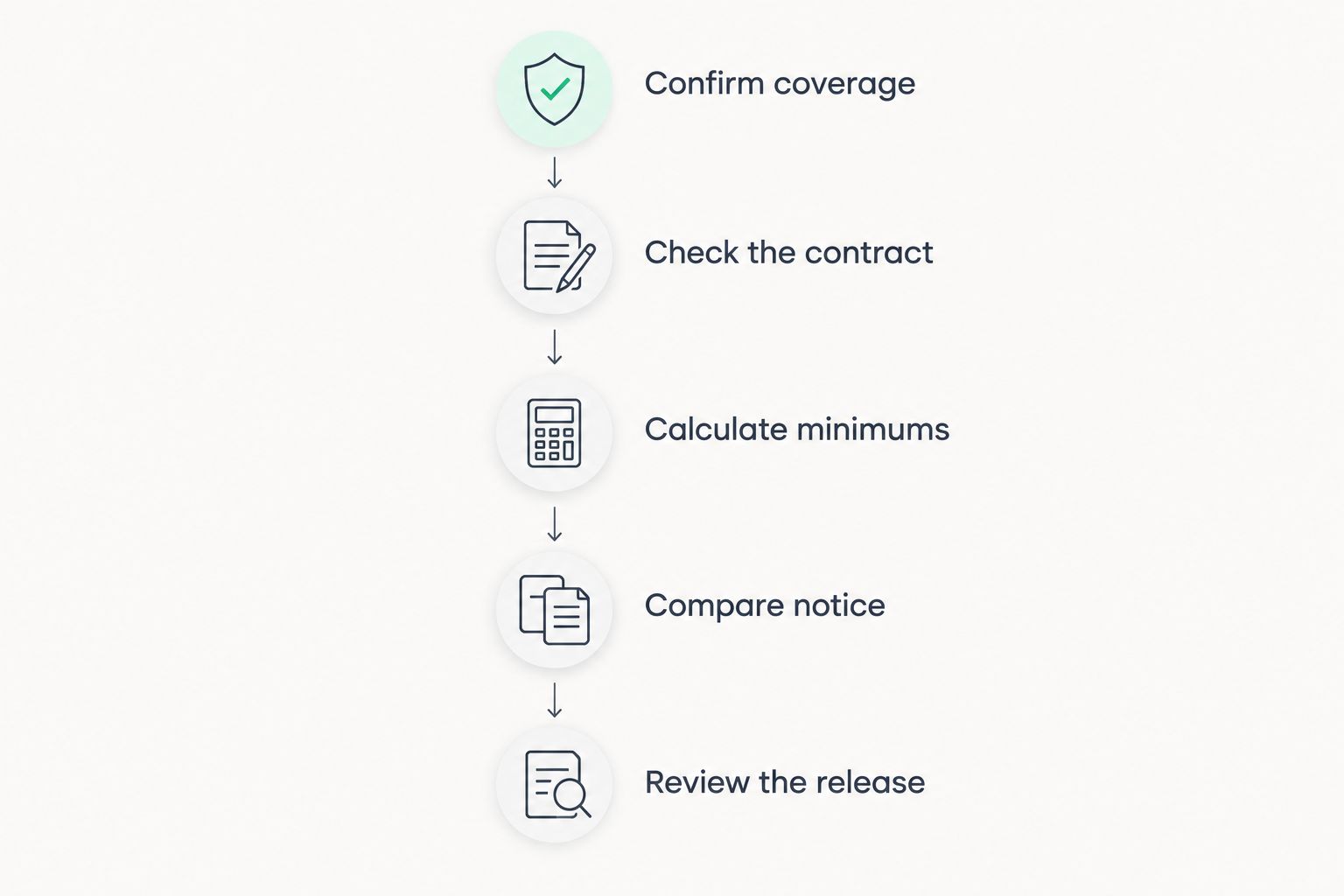
Use the following sequence for a 2026 termination-package review. It keeps legal eligibility separate from arithmetic and makes the eventual discussion with a lawyer more focused.
Confirm coverage
Check whether Ontario's ESA governs the employment relationship. Working in Ontario does not by itself establish provincial coverage; federally regulated employment follows a different statutory framework.
Check the contract
Gather the signed employment agreement and later amendments. An enforceable termination provision can affect entitlement to common-law notice, so do not skip directly from years of service to a projected payment.
Calculate minimums
Calculate ESA termination pay and check statutory severance separately. Record whether the offer includes working notice, pay in lieu or a combination, because these are not interchangeable descriptions of an unexplained lump sum.
Compare notice
Use the common-law estimate as a separate comparison. Then examine compensation components such as benefits, commissions and bonuses rather than assuming that base salary captures everything.
Review the release
Read the release alongside the offer. A settlement can require you to give up claims, so the calculation and the document need to be assessed together before acceptance.
Which reasonable notice calculator should you choose?
Choose a common-law reasonable notice calculator first if your question is whether a long-service termination offer deserves closer review. Use the ESA termination-pay and severance-pay calculations to identify the statutory components, not as substitutes for that broader assessment.
When searching for a reasonable notice calculator Ontario employees can use in 2026, reject any tool that treats a year of service as an automatic month of notice. Also reject the assumption that every employee with the same service length has the same entitlement.
Your most useful output is a comparison sheet: the employer's offer, the statutory components, the common-law estimate and the unresolved contract questions. That is a decision aid; a standalone headline figure is not.
FAQ
What’s the best reasonable notice calculator for a long-term Ontario employee?
A common-law reasonable notice calculator is the best starting point for estimating notice beyond ESA minimums. Check the contract and statutory entitlements separately before relying on the result.
Does Ontario require one month of notice for every year worked?
No. One month per year of service is not a legal formula for Ontario common-law reasonable notice. The assessment considers service alongside age, the character of employment and the availability of comparable work.
Is reasonable notice the same as ESA termination pay?
No. ESA termination pay addresses a statutory minimum, while common-law reasonable notice is a separate legal assessment. An enforceable employment contract can affect whether common-law notice applies.
Does every employee with five years of service receive statutory severance?
No. At least five years of employment is generally one eligibility requirement, but an employer-related statutory condition must also be satisfied. Service alone does not establish entitlement.
Can I add statutory severance to a common-law calculator result?
Do not automatically add statutory severance to a common-law calculator result. Common-law notice damages generally account for statutory payments, and the treatment of the proposed package needs to be checked to avoid double counting.
Does a notice calculator include bonuses and benefits?
Do not assume that a notice calculator includes bonuses and benefits. Check the tool’s stated compensation scope and have the relevant employment and compensation terms reviewed.
Should I sign a release if the offer matches a calculator?
A matching calculator result is not enough to justify signing a release. The contract, compensation terms, statutory entitlements and claims being released still need review.
One last thing
The difference between two calculators can be a difference in legal questions, not a calculation error. An ESA tool and a common-law tool can produce different periods without either claiming to measure the same entitlement.
Before accepting an offer, ask for a written breakdown of what each payment covers. That single document makes it easier to spot omitted components, misunderstood labels and amounts counted twice.
This article provides general Ontario employment-law information for 2026, not legal advice about an individual dismissal.