By Fran Jakubowicz | Founder and CEO, SunHouse Marketing | Fractional CMO
In October 2026, I spent US$2,000 testing ChatGPT Ads for SunHouse’s fractional CMO services. I wanted to see whether the ads could bring in the kinds of companies I work with and whether generative engine advertising (GEA) deserved a place in my paid media strategy. That meant following the inquiries through to sales so I could see what the campaign actually produced.
The campaign generated 18 inquiries. Three met our qualification criteria for a fractional CMO engagement, and one became a client. That engagement made the initial test economically worthwhile for SunHouse, although one client is not enough evidence to judge the channel’s long-term scalability.
The next decision was whether to commit more budget. To assess that, I looked at the cost of attracting a qualified prospect, how those inquiries progressed, and how the results compared with our established channels.
How I ran the SunHouse campaign
The campaign ran throughout the month of October. I used a US$500 OpenAI ad credit on top of US$1,500 of my own budget and spent the full US$2,000. I focused on one offer, a free audit, and sent people to a dedicated Unbounce landing page with dynamic copy.
The ads generated 109,900 impressions and 890 clicks, a 0.81% click-through rate, at US$2.25 per click. Eighteen inquiries came in, approximately 2% of ad clicks. Using the full campaign spend, including the ad credit, that works out to about US$111 per inquiry and US$667 per qualified inquiry.
I checked form submissions, calendar bookings and traced the inquiries back to the ad landing page. That gave me a way to follow the leads into the sales funnel to see where prospects dropped off.
ChatGPT Ads may reach a buyer during an active decision-making conversation
Consider a business owner trying to decide whether to hire a marketing director, retain an agency, or bring in a fractional CMO. They may begin with a broad question and then add details about their team, budget, growth targets, and the problems they need to solve. By the end of that exchange, their requirements may be much clearer than they were at the start.
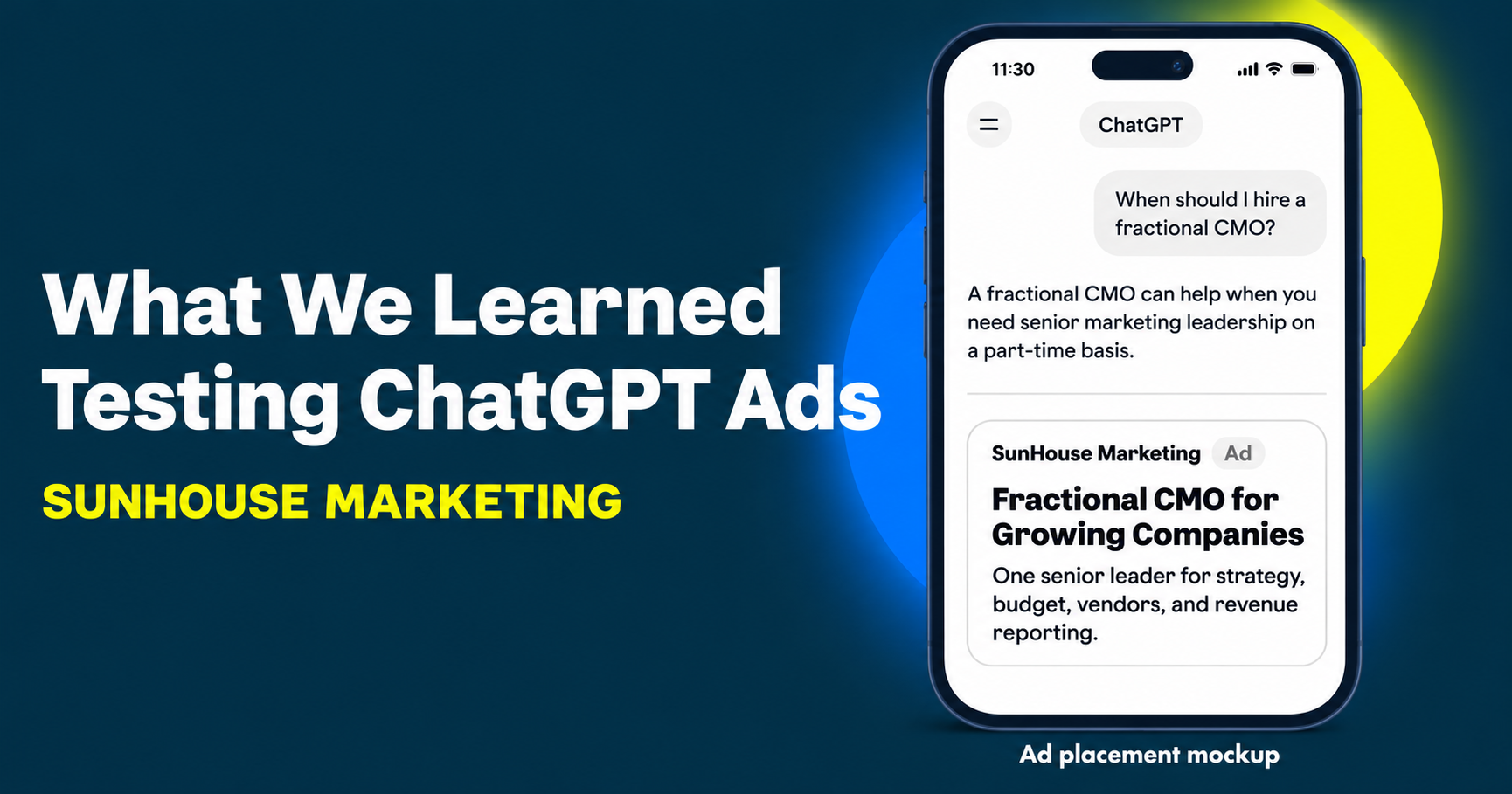
A relevant, clearly labeled ad can give that buyer a next step as they work through the decision. OpenAI says its ad system considers the current conversation alongside the ad copy, landing page, context hints and campaign targeting selections. Ads appear separately from ChatGPT’s answers, and advertisers do not receive the conversations that led to a placement.
In practice, an ad may appear below ChatGPT’s response. It can include the advertiser’s name, logo, headline, description, image and a link to a landing page.
How ChatGPT Ads context hints work
Context hints are additional information advertisers provide about their business, the customers they serve and the situations in which their offering is useful. They help the system assess relevance. They are not exact-match keywords, and they do not guarantee placement in a particular conversation.
OpenAI’s context-hint guidance recommends using a natural phrase focused on one idea.
For a fractional CMO offer, an example would be “marketing leadership for a CEO still managing outside agencies.” This describes a specific customer situation and explains why the service may be relevant, rather than simply repeating a generic phrase such as “marketing consultant.”
Context hints should reflect the offer accurately and be updated when pricing, availability, service areas, or service details change. They can describe a genuine use case, but wanting to reach a particular customer group does not by itself make an offering relevant to that group.
It is also important to distinguish context hints from delivery controls. A hint such as “fractional CMO services available in India” describes the business and its service area. A request to show the ad only to people in India is a delivery instruction. Use the campaign’s supported location controls to set the service area, because context hints cannot enforce geographic limits, schedules, or exclusions.
For advertisers, the practical approach is to organize hints around one clear product, service, theme, or customer need. If different use cases require different messaging or landing pages, such as a fractional CMO offer for SaaS founders versus one for ecommerce operators, consider creating separate ad groups.
ChatGPT Ads context hints help the system understand when an offer may fit a conversation. They do not let an advertiser dictate the conversation, force a placement, or turn a broad description into a targeting rule.
What the landing page needs to do
The page’s most important job was not simply to generate form fills. It needed to help a prospect decide whether fractional CMO support was the right model before requesting an audit. In our test, the inquiries that progressed tended to arrive with a clearer sense of the problem they wanted solved; the landing page needed to reinforce that clarity rather than merely describe the service.A buyer coming from a detailed conversation may have a specific question in mind. I’d use the landing page to answer the questions that affect whether someone books a call.
For a fractional CMO service, the page should make the offer concrete. Explain who makes marketing decisions, how the CMO works with existing staff and outside agencies, what the engagement includes, what the expected outcomes are, and what happens after someone requests an audit. These details help a potential customer assess fit before they commit time to a conversation.
A strong landing page should also address the buyer’s likely comparison. For example, it can explain when a fractional CMO makes sense, how the engagement differs from hiring a full-time marketing director or retaining an agency, and what level of involvement the business can expect. Clear service scope, pricing signals, proof of relevant experience, and a simple next step can reduce uncertainty for a high-consideration purchase.
The landing page is not only for the visitor. OpenAI’s ad system also considers it when assessing relevance, and OpenAI recommends sending ad traffic to the most relevant destination rather than defaulting to a homepage.
That means the page should clearly state what is being offered, who it is for, and what problem it solves. If the ad is aimed at a CEO considering fractional marketing leadership, the landing page should reinforce that same message rather than introduce a different offer, audience, or conversion goal.
A useful rule is simple: if the ad raises a question, the landing page should answer it. If it promises marketing leadership for a growing business, the page should explain what that leadership involves, who it is best suited for, and what the next step looks like.
How I measure ChatGPT Ads lead quality
Before I increase spend, I want to see the cost per qualified opportunity and whether the leads are moving through sales. I asked myself the following questions:
- Are inquiries coming from people in the right market who need the service and meet the business’s qualification criteria?
- Do those inquiries become useful sales conversations with prospects who have a defined need and a realistic path to engagement?
- What does a qualified opportunity cost, and how does the eventual acquisition cost compare with the value and margin of a customer?
- Has enough time passed to assess sales progress? In my business, an inquiry can take months to become a client.
Before launching, agree on a test budget, define a qualified inquiry and make sure the ad source carries through into the CRM. OpenAI’s conversion measurement can report actions such as form submissions when tracking is configured. OpenAI gives advertisers aggregated, non-identifying performance information such as views and clicks, so the CRM is where you see which of those inquiries progressed.
If inquiries are irrelevant, the targeting, message and offer need review. If suitable visitors arrive but do not inquire, the landing page and next step deserve attention. If qualified inquiries arrive but do not progress, the sales process and buying timeframe need examination before assuming the channel is at fault.
How ChatGPT Ads fit alongside Google Ads and other channels
Google Search remains valuable for reaching people who express a need through a search query. Meta can introduce an offer, build demand and bring previous visitors back. LinkedIn can be useful where professional identity and company characteristics matter. The contribution of each depends on the business and the campaign.
An October working paper by Maximilian Kaiser and Christian Schulze reported US$0.89 in revenue per paid ChatGPT session compared with US$2.45 per paid Google Search session in its U.S. ecommerce sample.
Those figures, according to ecommerceresearch.org are useful as an early benchmark, but they should not be treated as a forecast for every business. The working paper covers 1,898 online shops overall, but the paid-channel revenue comparison uses a smaller sample of 102 advertisers. That comparison measures revenue per session, not B2B lead quality, sales-cycle length, or customer lifetime value.
For a fractional CMO campaign, I would compare cost per qualified opportunity and closed business over a comparable sales window. A lower click-through rate or conversion rate may be acceptable if ChatGPT Ads produce better-qualified conversations, larger deal sizes, or prospects with a clearer understanding of the service.
For SunHouse, the relevant benchmark was not revenue per ChatGPT session. It was whether the channel could produce qualified fractional CMO opportunities at a cost that could support a longer sales cycle.
Reachable Audience
The reachable audience also matters. OpenAI currently says ads may appear for eligible Free and Go users, while Plus, Pro, Business, Enterprise, and Edu accounts are ad-free. A B2B advertiser should consider that limitation when estimating how much of its intended audience it can reach.
It is also worth treating ChatGPT Ads as a channel to test, not a replacement for established demand-capture channels. Google Search can still capture buyers searching for “fractional CMO,” “interim CMO,” or “marketing leadership for SaaS companies.” ChatGPT Ads may be more useful for reaching someone who explains a broader problem, such as inconsistent marketing execution, unclear channel strategy, or the need for senior marketing leadership without a full-time hire.
A practical testing approach would be to run comparable offers across channels where possible, use consistent UTM parameters and conversion definitions, and evaluate ChatGPT Ads against the same outcome metrics used for Google Ads, Meta, and LinkedIn. OpenAI’s Ads Manager supports conversion measurement and CPC bidding, which makes that comparison more feasible, although attribution across a long B2B sales cycle still requires care.
The most useful question is not whether ChatGPT Ads outperform Google Ads in every metric. It is whether they add incremental qualified demand at an acceptable cost, especially among buyers who may not have used the precise search terms a conventional search campaign would target.
Healthcare and legal advertisers need an eligibility check. Eligibility for regulated categories depends on the service and market. OpenAI’s advertiser eligibility guidance lists requirements by category. Ads also do not appear in temporary chats or near sensitive topics, including personal health, mental health and politics, and users can turn off ad personalization.
Paid advertising and organic AI visibility serve different purposes
A sponsored placement in ChatGPT and a mention in an AI-generated answer are separate forms of visibility. Running ads does not purchase inclusion in the answer.
Organic AI visibility work focuses on making a business and its expertise easier for AI systems to find and substantiate using clear service information, useful content and credible independent references.
What the test means for my marketing budget
The October campaign brought SunHouse a client and made the initial investment worthwhile. It also gave me a clearer basis for deciding whether to spend more.
For now, our established channels are producing stronger results, so that is where I’m directing SunHouse’s next marketing dollars. I would revisit ChatGPT Ads when there is a specific opportunity to test, with a defined offer, reliable tracking, and enough time to follow qualified inquiries through the sales cycle.This was a single-month, single-offer test. One client is a meaningful commercial outcome, but it is not enough to establish a reliable cost per acquisition or to generalize the result to every B2B service business. The purpose of the test was to determine whether ChatGPT Ads deserved further investment, not to declare them a proven primary channel.
If I ran the next test, I would focus on three variables:
Offer: Compare a diagnostic audit with a more specific “marketing leadership assessment” to see which attracts better-fit prospects.
Context hints: Test separate ad groups for founder-led companies, SaaS operators, and businesses already working with agencies.
Landing page: Test a more explicit qualification page against the current audit page, with clearer expectations around engagement scope and next steps.
A successful test earns further consideration. Increasing spend requires evidence that the channel can keep producing commercially valuable business.
Speak with SunHouse Marketing about where to focus your marketing budget to generate qualified leads and support sustainable revenue growth.