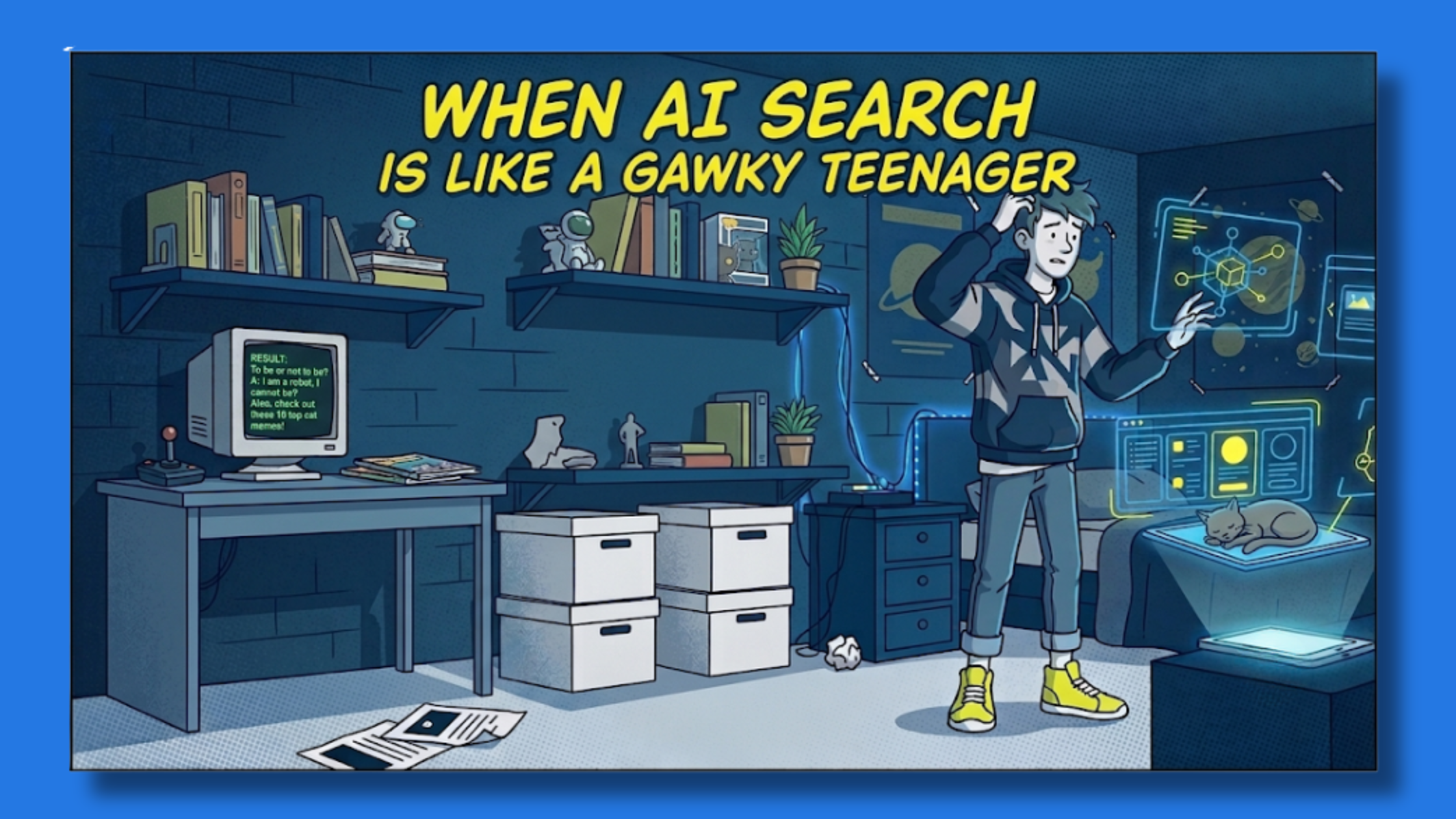
AI search has entered its gawky teenager phase, outgrowing its old look, not yet sure of its new one and still trying on different answers to see what fits.
And like any teenager, it’s attracting no shortage of opinions about how it should grow up.
Since May, Google has published its first direct guidance on generative search, retired a long-standing search feature, and expanded a new AI-driven local search capability into an entirely new business category. Academic researchers have added a body of evidence about how AI systems actually select and present information. And a fair number of the tactics circulating across the SEO industry have turned out to be either unnecessary or simply misunderstood.
Not everything changed; some long-standing practices have held up. The challenge for businesses is separating meaningful change from hallway rumors. After reviewing the latest research, Google’s guidance, and what we are seeing across client campaigns, here are the developments that actually matter.
FAQs Are NOT Dead.
Apparently, nothing in SEO is complete until someone declares it “dead.” FAQ sections joined that long list this year after Google removed FAQ rich results from search results.
The confusion is understandable.
Google removed FAQ rich results from search, meaning the expandable FAQ listings that used to appear beneath some pages are no longer a visibility opportunity. But that’s a change to one search feature not a verdict on FAQ content itself.
Google has been able to read content inside tabs, accordions, and expandable sections for years, provided that content lives in the page’s HTML rather than loading only after a click or an API call.
What changed is the job FAQs are doing. They used to be a way to earn a bit of extra search real estate. Now they’re an opportunity to answer real customer questions clearly enough that both search engines and AI systems can rely on the answer.
A well-written response to a genuine customer concern can help:
- users make decisions faster
- search engines understand page relevance
- AI systems identify reliable information to reference
One final note on FAQs: continue adding internal links within your FAQ sections, but for a new reason. They improve content architecture, helping users find deeper resources, and showing how related topics connect across your site.
Google Has Finally Put Speculation to Rest
For much of the past year, the SEO industry has been filled with chatter about optimizing for AI search.
Should businesses build AI-specific pages (no)? Does every website need an llms.txt file (no)? Should content be rewritten specifically for large language models (no)? Does classic SEO still apply (yes)? Should content be genuinely helpful and non-commodity (yes)? Do inauthentic mentions across blogs and forums boost AI citations (no)? Do technical clarity, crawlability, indexing, page experience still matter (yes)? Is overhauling your schema markup the key to AI visibility (no)?
Google settled most of these questions directly with its recent guidance. The message was consistent: businesses don’t need a separate version of SEO built for AI systems. The qualities that have always driven strong search performance still do the work:
- original expertise
- accurate information
- useful answers
- clear demonstrations of experience
- content built for people
Google also pushed back specifically on several proposed AI-optimization tactics, including AI-only content and technical additions marketed as a substitute for quality.
This brings the focus back to something that has always been hard to manufacture: credibility.
The Research Points to One Consistent Advantage
If AI search has changed one thing about content, it’s the weight evidence now carries.
Research from Princeton University, Georgia Tech, the Allen Institute for AI, and IIT Delhi examined how content characteristics influence visibility in AI-generated responses.
Content backed by credible citations, statistics, and authoritative references performed significantly better than content that wasn’t.
And it makes perfect sense. AI models are designed to identify, summarize, and connect information from sources they judge trustworthy. A page that simply expresses an opinion carries less weight than one that explains an idea, supports it with evidence, and demonstrates firsthand knowledge.
Consider how people evaluate businesses. A testimonial on your own website tells customers what you say about yourself. A review on an independent platform provides outside validation. Both have value, but they serve different purposes. AI systems are increasingly looking for the same signals: not just what a brand claims about itself, but what credible sources can verify.
For businesses, the opportunity is specific: expertise should not only be claimed. It should be demonstrated through original research, client insights, industry data, real process explanations, and citations to reputable sources.
The companies most likely to be referenced by AI systems won’t necessarily be the ones publishing the most. They’ll be the ones creating information that’s difficult to replace.
Brand Visibility Extends Way Beyond Your Own Website
Search engines and AI systems have been relying on signals from across the web to build a clearer picture of a brand for years. This is only intensifying.
Reviews, industry publications, directories, social profiles, and third-party mentions all shape how a brand gets understood. This directly impacts when AI systems try to answer questions like “who are the best providers for this service,” “which company should I consider,” or “is this business trustworthy.”
Which is exactly why consistency across those sources is so darn important. Your website, LinkedIn presence, Google Business Profile, review platforms, and industry profiles should all describe your company the same way. Different descriptions, inconsistent services, outdated information, or conflicting details create uncertainty that AI systems have no reason to resolve in your favor.
Rankings Are Only Part of the Picture
For years, SEO reporting centered on a familiar set of measurements: keyword rankings, impressions, organic traffic, conversions. Those metrics still count, but they just don’t capture the whole picture.
AI-generated search experiences now answer plenty of questions before a user ever visits a website, which means a brand can shape a buying decision without a single click. That raises a second measurement question: is your business actually appearing as a trusted source?
A company sitting in position one but absent from AI-generated answers may look stronger in a traditional report than its real visibility supports. A brand that shows up consistently inside those answers, on the other hand, may be shaping decisions earlier in the buying journey than any ranking report would suggest.
Ranking remains important, but it’s no longer the only measure of visibility.
Local Search Is Changing Too
AI isn’t only reshaping informational search. It’s changing how customers find and interact with local businesses too.
Google’s “Ask for Me” feature, which lets Google’s AI call a business directly to ask about services, pricing, and availability is expanding into home services in 2026, after starting with categories like auto shops and nail salons. That expansion raises the stakes on something that should already be a given: accurate business information.
If your hours, services, pricing, or contact details are inconsistent across platforms, the customer experience — or in this case, the AI’s experience on the customer’s behalf — breaks down before a conversation even starts.
For local businesses, the fundamentals haven’t changed:
- maintaining an accurate Google Business Profile
- collecting genuine customer reviews
- responding to customer feedback
- keeping service information current
Another authentic review is still worth more than another directory listing.
What We Are Changing for Clients
None of this has changed our overall approach. It’s reinforced it.
We’re spending less time chasing individual search features and more time building visibility that holds up regardless of which feature Google ships next. In practice, that means:
- Creating content that answers customer questions directly, not around them.
- Developing pages based on expertise rather than keyword volume.
- Adding evidence, research, and original insight wherever we can.
- Strengthening brand consistency across the places customers and AI systems actually look.
- Measuring not just where a company ranks, but whether it’s being referenced.
That last point is the whole thesis, really. Ranking tells you where you show up in a list. Being referenced tells you whether an AI system or a customer doing their own research decided your business was worth mentioning by name.
None of this played out over years. It happened in two months. But that’s the thing about growth spurts: they’re fast, unpredictable, and noisy.
AI search will eventually mature and settle into who it’s going to be. In the meantime, the trick isn’t overreacting to every mood swing; it’s knowing which changes represent fundamental growth and which are just passing awkwardness. That distinction is a lot easier to make when you have someone steady guiding you through the noise.